
Ten fence materials compared on lifespan, upkeep, relative cost and fire rules, with what each one is bad at and what the Central Coast changes.
Material decides everything that comes after it: how often you work on the fence, when the posts give out, and what the fence is allowed to do next to your house. This guide compares ten materials on lifespan, upkeep and cost, and says plainly what each one is bad at.
Three things are specific to California’s Central Coast. Salt air attacks metal and hardware far more than it attacks wood. New combustible fences are now barred within 5 feet of a house in fire-prone areas. And Monterey County reviews fence material and colour in its design districts.
How to choose a fence material
Four questions decide it. How long will it last, how much upkeep will you actually do, where does it sit on cost compared with the others, and what does the fence have to do? Privacy, containing a dog, a pool barrier and standing near a house in a fire-prone area all point to different materials.
The bars on each card are relative across these ten materials. A fuller bar means more of the named thing, so a full Upkeep bar means the most work. Lifespans are national ranges. No one has published service-life data for the Central Coast, so this page does not claim any.
Wood fails at the ground line. Rot needs wet wood, and humid air alone does not wet wood enough to decay it. Fog’s effect is surface mould and slow drying. What rots is the buried post, where water sits. Posts in soil need pressure treatment to AWPA UC4A at minimum, and UC4B if embedded. Borate-treated lumber is for above-ground use only and fails in the ground.
Salt air is mostly a metal problem, and fasteners fail before the panel does. FEMA’s coastal corrosion guidance traces storm failures to connections more often than to the members they join. Specify G185 hot-dip galvanised or stainless steel, and 316 stainless over 304 near salt air. Copper-treated wood corrodes ordinary steel, and mechanically galvanised hardware is discouraged on the coast.
Quick picks by what you need
Fence materials compared
| Material | Lifespan | Upkeep | Cost | Coastal | Best for | Fire (5 ft) |
|---|---|---|---|---|---|---|
| Pressure-treated pine | 12–18 yrs | High | $ | Fair | Budget privacy | Combustible (fails E136) |
| Western red cedar | 20–25 yrs | Moderate | $$ | Good above ground | Privacy, curb appeal | Combustible (fails E136) |
| Redwood | 20–30 yrs, by grade | Moderate | $$ | Good (heartwood) | Natural look, privacy | Combustible (fails E136) |
| Vinyl / PVC | 25–30 yrs | Very low | $$$ | Very good | Low-upkeep privacy | Combustible (fails E136) |
| Composite | 25–40 yrs | Very low | $$$$ | Good (capped only) | Long life, no staining | Combustible (fails E136) |
| Chain link, galvanized | 15–30 yrs, less near salt water | Low | $ | Fair | Security, containment | Non-combustible (steel) |
| Ornamental aluminium | 30–50 yrs | Very low | $$$ | Very good | Front yard, pool, HOA | Non-combustible (ASTM E136) |
| Ornamental steel | 20–50+ yrs if coated | Moderate | $$$$ | Poor unless coated | Security, estates | Non-combustible (ASTM E136) |
| Hog wire + wood frame | 15–25 yrs | Moderate | $$ | Fair | Rural, view-through | Combustible (wood frame) |
| Corrugated metal | 25–40 yrs | Low | $$$ | Good with heavy coating | Modern privacy | Non-combustible (steel) |
Fences within 5 feet of a house: California’s Zone 0 rule
California Building Code Chapter 7A, the wildfire building code, does not cover fences. Its scope is buildings and structures, and it has moved into the California Wildland-Urban Interface Code, which is also written for buildings. The rule aimed at fences is Zone 0, the five feet around a structure, set by the State Board of Forestry under Public Resources Code 4291 (14 CCR 1298.03(c)(4) and 1299.03(e)(4)).
Zone 0 is the 5 feet around a structure. As proposed, it does four things:
- No new or replaced combustible fence within 5 feet of a structure.
- A non-combustible gate or panel within 5 feet of the point where a fence attaches to a structure.
- Existing fences may stay and may be repaired with the same material.
- Fences more than 5 feet from the structure are not affected.
Combustible is decided by a test, not by a description. Non-combustible means the material passes ASTM E136. Steel, aluminium, fibre cement and masonry pass; wood, composite and vinyl fail. Vinyl surprises people here, because it does not rot and it does not burn like timber, but it is plastic and it fails the test. The practical answer is a metal gate or panel against the house, with wood or vinyl continuing past the 5-foot mark. Fire-retardant-treated wood has been proposed as a conditional exception where it runs parallel to the wall and stands off a minimum distance.
These rules are recent and still being finalised, and some fire districts have adopted their own version ahead of the state. Compliance for existing homes has been targeted at February 2029. Check your parcel’s fire hazard severity zone and the current requirement with your local fire authority before you plan.
The ten materials
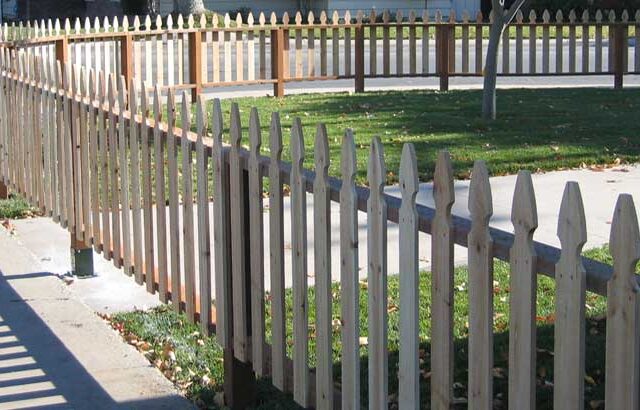
Pressure-treated pine
Bars are relative across the materials in this guide, not a score.
The cheapest wood fence and the easiest to source. Posts can be bought rated for ground contact, which covers the part that usually fails first. It takes stain and paint, and individual boards are simple to swap. A sensible choice for long runs where budget is the limit.
Treatment is a shell, not the whole board, so every cut exposes untreated core. Stain wears off and boards check and warp unless you redo it. Posts need UC4A at minimum and UC4B if embedded; borate-treated lumber is above-ground only. Unmaintained, expect roughly 8–12 years. It is combustible, so no new pine fence within 5 feet of a house in a Zone 0 area.
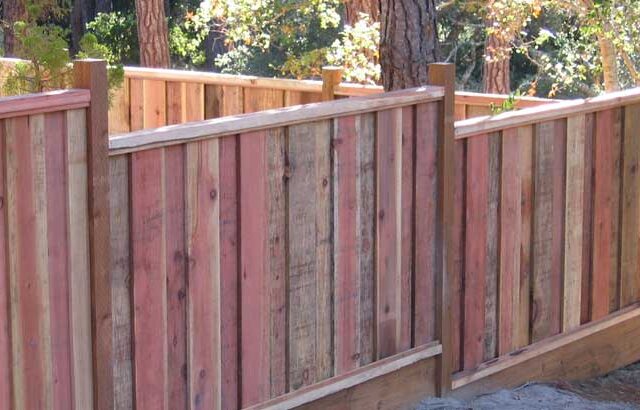
Western red cedar
Cedar heartwood resists decay and termites without chemical treatment, and it weathers evenly or takes stain well. Best above ground, as pickets and boards where appearance counts.
That resistance is heartwood only. Sapwood is not resistant, and a lot of cedar fencing includes it, so the grade matters more than the species name. Even heartwood rates only as resistant, not very resistant, so a cedar post in the ground is a weaker bet than a UC4A or UC4B treated post. Plain steel fasteners stain and corrode in it. It is combustible, so it is out new within 5 feet of a house in a Zone 0 area.
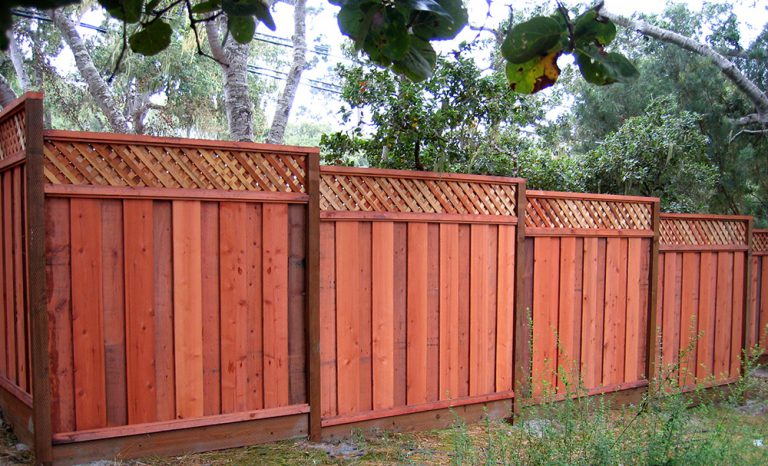
Redwood
California’s own fencing wood. Heartwood resists decay and termites, and old-growth redwood has the highest decay rating of any fence wood here. In a University of California test, redwood boards set 24 inches into soil with no preservative all survived 12 years.
Most redwood sold today is young-growth, which rates only moderate for decay. Sapwood grades such as construction common are not resistant. Posts and anything near soil should be construction heart or better, so read the grade on the quote. Grade matters more than the species name. It is combustible, so no new redwood fence within 5 feet of a house in a Zone 0 area, and supply has tightened since harvests fell.

Vinyl / PVC
It does not rot, rust or feed termites, and salt fog does not attack it. Washing is the whole job. A solid panel can work as a pool barrier if it meets the height and climbability rules.
UV fades it, and some fade is normal rather than a defect. Cold and impact crack it, and a cracked panel is replaced, not repaired. Quality varies widely between heavy virgin-vinyl profiles and thin budget panels, so the grade matters more than the material. Mould collects in fog and has to be washed off. It is plastic, so treat it as combustible within 5 feet of a house. Independent coastal test data is thin.
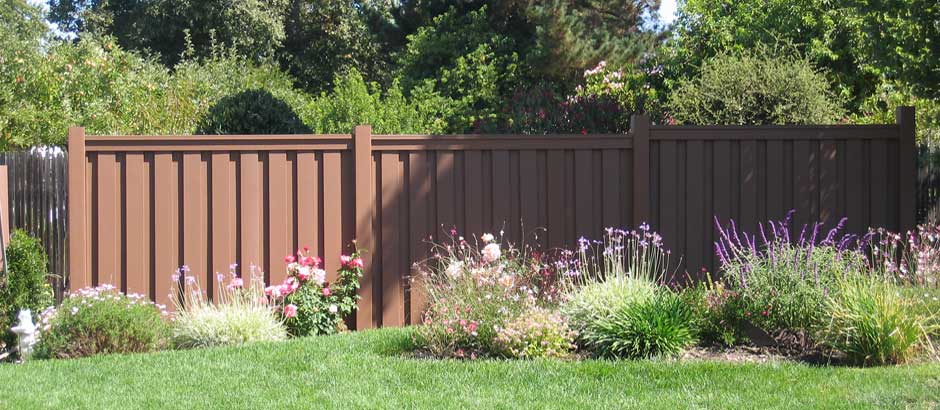
Composite
No rot, no termites, no staining. Capped (co-extruded) boards shed water and block UV, so the look holds with washing alone. Longest life with the least work.
The highest cost band here. First-generation uncapped composite absorbs water, swells and grows mould, and is the wrong pick near the coast. Some warranties exclude coastal or marine sites in the fine print, so read it. Fade is common. It is combustible, so no new composite within 5 feet of a house in a Zone 0 area. Most of the coastal performance claims come from manufacturers.
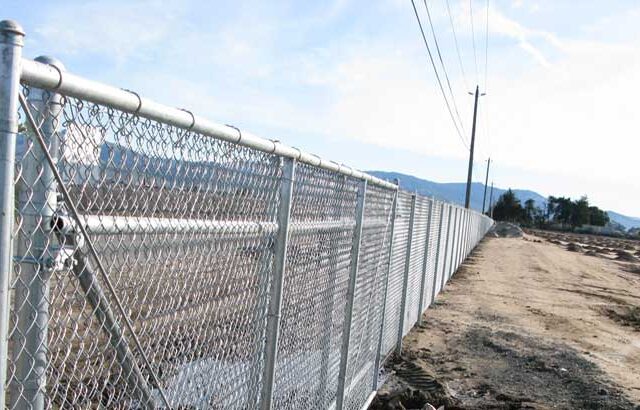
Chain link, galvanized
The fastest and cheapest way to enclose land. It suits dogs, acreage and commercial boundaries. Steel is non-combustible, so it can sit against a house in a Zone 0 area.
No privacy, and plain looks. Salt water degrades galvanised chain link much faster than inland. The zinc is used up, then the steel rusts, starting at cut ends, welds and sheltered faces that rain never rinses. The widely quoted five-year figure comes from warm-water coasts and does not transfer to this cold-upwelling one, so the honest statement is the direction: shorter than inland. Ask for heavy zinc (ASTM A392 Class 2) or coated fabric near the water.
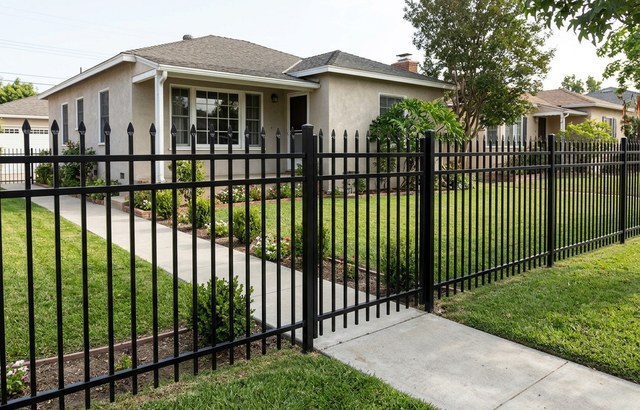
Ornamental aluminium
It does not rust, which makes it the best of the metals for salt air. It is light and non-combustible. Vertical-picket styles are the usual route to a pool barrier: 60 inches high, 2 inches maximum gap at the bottom, no opening that passes a 4-inch sphere, nothing to climb.
You can see straight through it, so it gives no privacy. The finish and the hardware go before the metal does. Ask for powder coat to AAMA 2604 at minimum, 2605 near salt water. Steel hinges and screws on aluminium corrode and can attack it, so use stainless or marine-grade hardware. Panels dent. The coastal ratings rest mostly on trade sources.
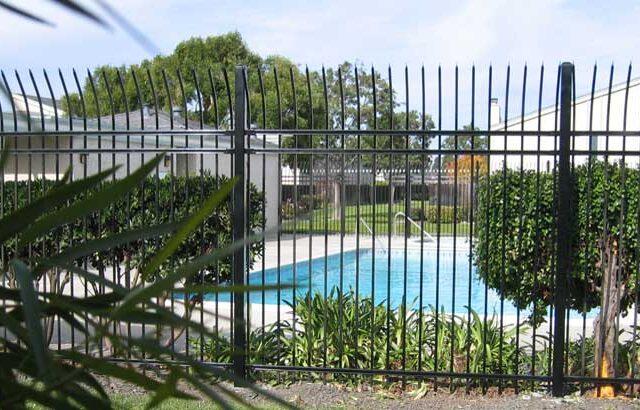
Ornamental steel
The strongest and most secure option, and non-combustible, so it can stand against the house in a Zone 0 area. Inland, with the coating kept up, it can outlast the house.
Rust is the worst failure of any metal here, and salt air speeds it. Most so-called wrought iron is mild steel tube, and every chip or scratch becomes a rust point. Near salt water it is a repaint schedule, not set-and-forget. Hot-dip galvanising plus powder coat holds up far better than paint alone. Bare steel hardware streaks rust within a season. A bright metal finish can also be refused in a Monterey design district.
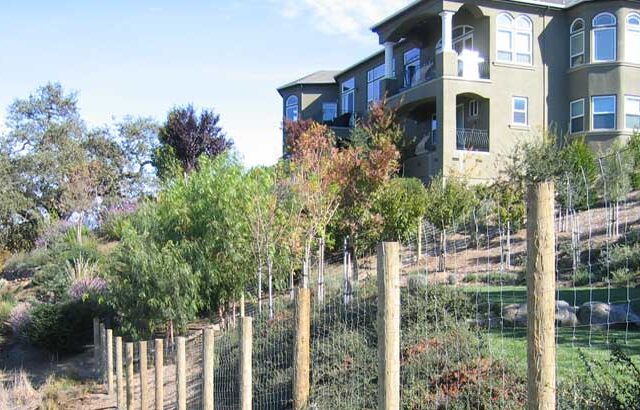
Hog wire + wood frame
Welded wire panels keep stock and pets in without blocking the view. They suit rural lots, and the wire usually outlasts everything around it.
The wood frame sets the lifespan. Posts and rails rot at the ground long before the mesh gives out, so put the money into UC4A or UC4B treated or heartwood posts. There is no privacy. Thin-galvanised wire rusts at cut ends. A wood frame is combustible, so it is out new within 5 feet of a house in a Zone 0 area. A dog that wants out can still get through or over it.
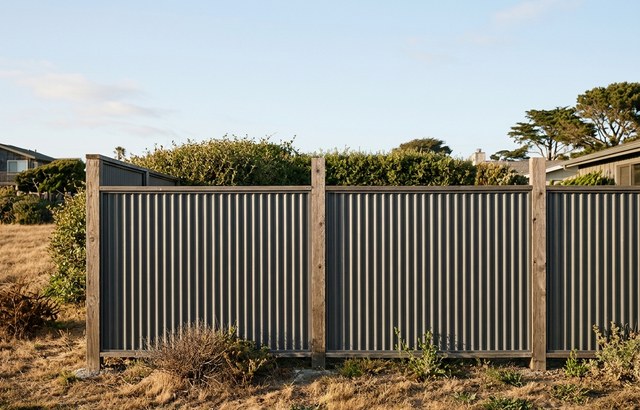
Corrugated metal
Solid privacy in a thin profile, with no rot and no termites. Steel panels are non-combustible. The look suits modern and rural builds.
Cut edges and fasteners rust before the panels do. Seal every field cut, and near salt water choose Galvalume or heavy G90 zinc with factory paint. A solid sheet acts as a sail, so post spacing and embedment have to be engineered for wind, not guessed. It is loud in rain, can look industrial, and may be refused where design review controls material and colour. Coastal life evidence comes from trade sources only.
Not sure which material suits your site?
Tell us where the fence is going and what it has to do. We will tell you which materials suit the site, including anything the fire, pool or design rules rule out.
What fence materials cost over 20 years
Cheap and restained often costs more than expensive and left alone. A fence that needs staining every few years, or posts replaced partway through, carries a cost the first quote never shows. Over twenty years the gap often reverses. It does not always: well-specified treated pine with posts rated UC4A or UC4B and regular staining can still be the cheapest way to enclose a yard.
Cost depends on more than the material. Run length, height, slope, gate count, soil and post depth, removal of the old fence and site access all move it. So does the grade you choose: heartwood over common, capped composite over uncapped, heavier zinc over lighter. Fire, pool and design-review rules can add a metal section or a specific product.
This page lists no prices. Published figures vary several-fold between sources and none are specific to this coast. We estimate on site, once we have seen the run, the ground and the gates.
Fence material FAQs
Which fence material lasts longest?
On national ranges, ornamental aluminium (30–50 years) and composite (25–40) last longest with little upkeep. Steel can last as long, but only while its coating is kept up. Wood and chain link fall short of those figures, and no one has published service-life data specific to the Central Coast.
What is the best fence material for coastal salt air?
Aluminium and vinyl are the strongest coastal choices, and capped composite is sound if the warranty has no coastal exclusion. Galvanised chain link and bare steel suffer most. Whatever the panel, use G185 galvanised or stainless fasteners, and 316 stainless over 304 near salt air.
Does coastal fog damage a wood fence?
Not by itself. Humid air does not wet wood enough to cause decay. Fog keeps surfaces damp longer and grows surface mould, which is cosmetic. Rot comes from moisture at the ground line, which is why post specification matters more than the species: UC4A at minimum, UC4B if embedded.
Can I build a wood fence right next to my house?
In a designated fire-prone area, probably not for a new or replaced fence. Zone 0 bans new combustible fences within 5 feet of a structure and requires a non-combustible gate or panel within 5 feet of where a fence attaches. Existing fences can stay and be repaired. Check your parcel’s fire zone.
What does a pool fence have to meet?
Under Health and Safety Code 115923, the barrier must be at least 60 inches high, have no more than a 2-inch gap at the bottom, and have no opening that passes a 4-inch sphere. It must be non-climbable, with a self-closing, self-latching gate. A removable mesh fence meeting ASTM F2286 is an allowed alternative.
Does Monterey County review fence material?
In its design control districts, yes. That covers Big Sur, Carmel, the Del Monte Forest and any parcel zoned D, S or VS. The county reviews a fence’s material and colour for viewshed and neighbourhood character even where no building permit is needed. Plain fences are usually approved over the counter.
Is cedar or redwood better for a fence?
Neither name decides it. Both resist decay only in the heartwood, and sapwood is not resistant. Old-growth redwood rates highest, but most supply today is young-growth, which rates moderate. Ask for the grade: construction heart redwood or heart-grade cedar for posts and anything near soil, and common grades only above ground.